


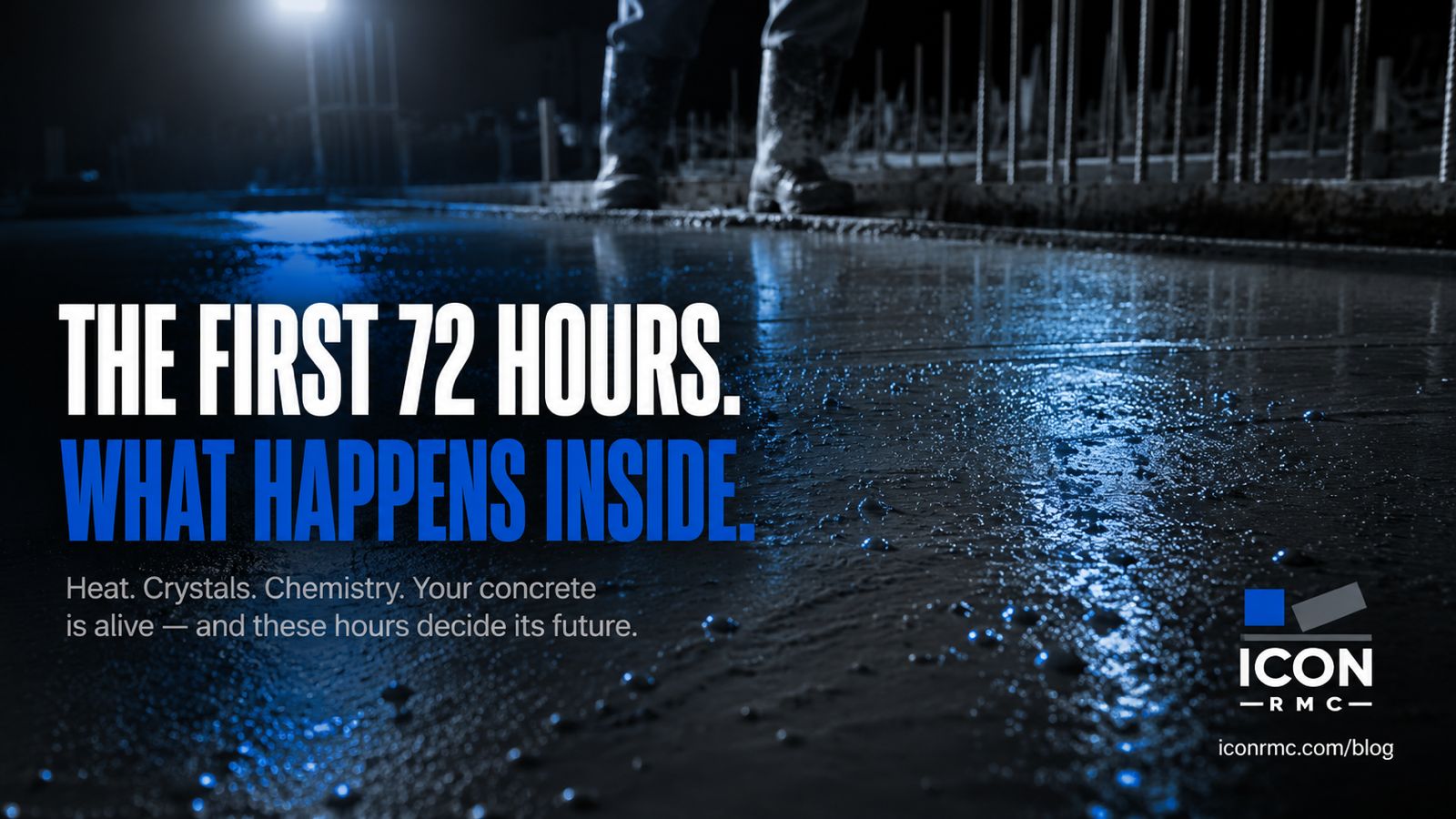
The mixer leaves. The slab is levelled. The crew goes home. From the outside, it looks like the job is done. Inside the concrete, the job has just begun. The first 72 hours after a pour are the most chemically active, thermally volatile, and structurally decisive period in your concrete's entire life.
Hour 0 to 1: The Dormant Period
Immediately after placement, the concrete enters what engineers call the dormant or induction period. The cement particles have made contact with water, and a thin layer of calcium silicate hydrate (C-S-H) has formed on their surfaces, but the reaction is slow. The mix is still workable. This is the window for finishing: levelling, floating, trowelling. Once this window closes, any disturbance to the surface creates weak planes that will crack later.
At Icon RMC, the mix design accounts for this window. Admixtures (plasticizers, retarders) are dosed at the batching plant to control exactly how long this workability lasts, matched to the site's distance, ambient temperature, and placement method.
Hour 1 to 6: Initial Setting
The reaction accelerates. Ettringite crystals form. The paste stiffens. This is initial setting, the point at which the concrete can no longer be moulded or moved. IS 456 defines the minimum initial setting time as 30 minutes for OPC. In practice, at Ahmedabad's summer temperatures (often above 40 degrees Celsius), this window can shrink.
If two layers of a pour are not bonded within this window, you get a cold joint: two pieces of concrete that sit next to each other but are never chemically connected. Cold joints are invisible from the surface but become leakage paths within 2 to 3 years. This is why mixer sequencing matters. At Icon RMC, GPS-tracked dispatch ensures the next mixer arrives before the previous layer crosses its initial set.
Hour 6 to 24: Final Setting and Early Strength
The hydration reaction is now fully active. Calcium hydroxide crystals grow. The temperature inside the concrete begins to rise: this is the heat of hydration, and in large pours (rafts, mass concrete), internal temperatures can exceed 65 degrees Celsius. If the surface cools faster than the core, the temperature differential creates thermal cracks. IS 456 recommends keeping the differential below 20 degrees Celsius.
Curing must begin within this window. Water curing (ponding, wet hessian, or curing compounds) prevents the surface from drying out faster than the interior. Skip this step, and plastic shrinkage cracks appear within hours. By hour 24, the concrete has reached roughly 15 to 20 percent of its design strength. It is standing, but it is not strong.
Hour 24 to 72: The Critical Growth Phase
This is where the real strength develops. C-S-H gel, the primary binding compound, fills the spaces between cement grains, densifying the matrix. The concrete is actively growing stronger by the hour. But it is also vulnerable. If curing water is withdrawn during this phase, the hydration reaction slows or stops entirely.
Industry data shows that concrete cured for only 3 days achieves roughly 60 percent of its 28-day potential. Concrete cured for 7 days reaches approximately 75 percent. Full 28-day curing approaches 99 percent. Every day of curing you skip costs you permanent, irrecoverable strength.
What This Means for Builders
First, never disturb a fresh pour after finishing is complete. No foot traffic, no stacking, no formwork removal until the engineer clears it. Second, start curing within 6 hours and do not stop for at least 7 days. Fourteen is better. Twenty-eight is ideal. Third, cast your cubes on day one. They are the only way to know, not guess, not assume, not hope, what your concrete actually achieved.
Conclusion
Concrete is not an instant material. It is a 28-day process that starts the moment water meets cement. The first 72 hours are the most critical, and the most neglected. Understanding what happens inside your concrete does not require an engineering degree. It requires attention.
Icon RMC: computer-batched precision, GPS-tracked delivery, and in-house testing for every batch. 24/7 Bharosa. Power to Conquer.