


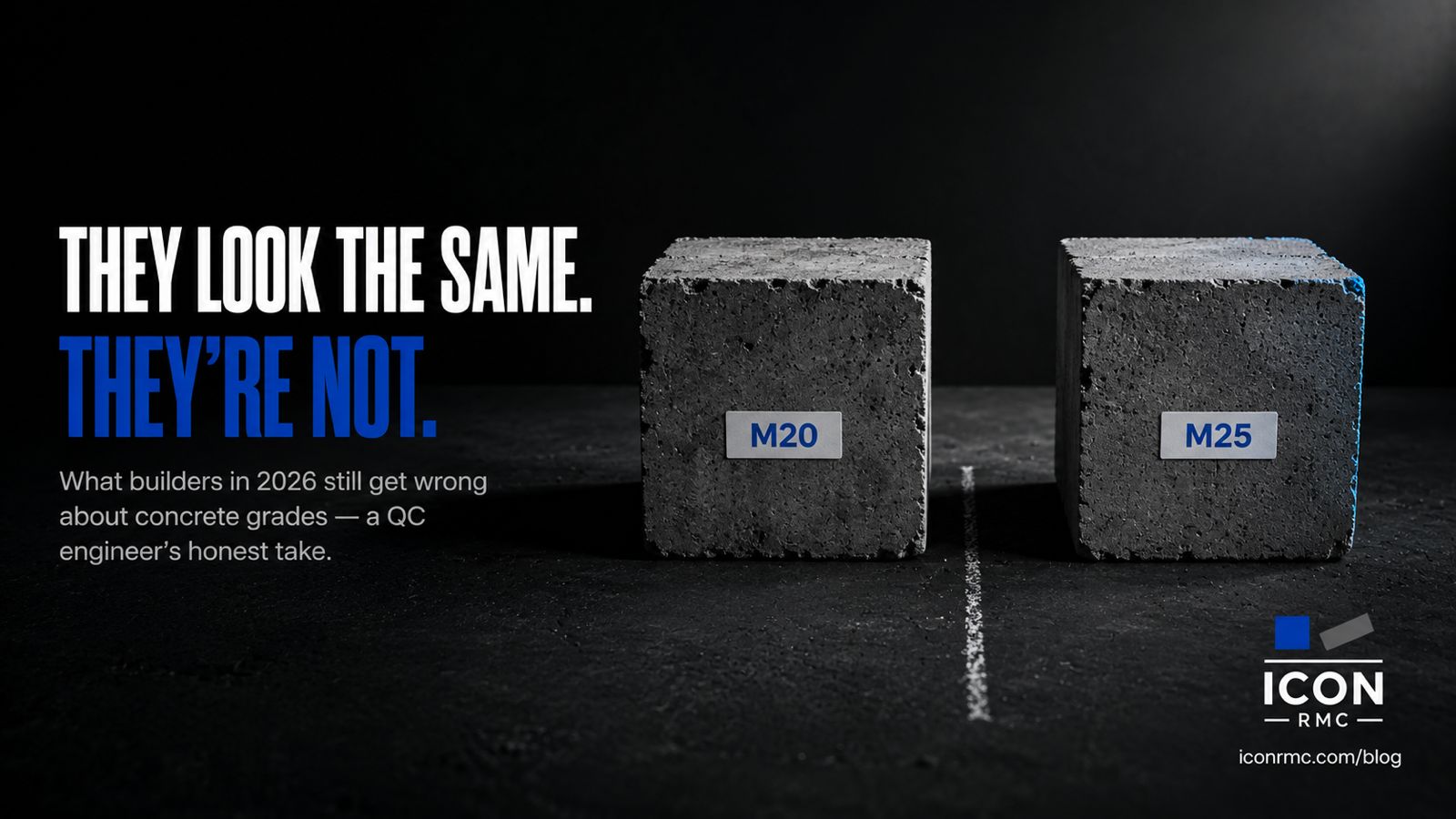
I have spent years in quality control, at batching plants, in labs, and on sites. And I can tell you that the most common concrete problem in 2026 is not bad material or poor workmanship. It is wrong grade selection. Not because builders are careless. But because the grade conversation usually goes like this: "M25 daal do," without anyone asking why M25, where M25, and whether M25 is actually what the structure needs.
Mistake 1: Using M25 for Everything
M25 has become the default grade for residential construction in Gujarat. Builders order it for slabs, columns, footings, PCC, staircase fill, boundary walls — everything. One grade, one order, simple. The problem: you are either overpaying or underbuilding, depending on the element.
IS 456 Table 5 specifies minimum grades based on exposure conditions. For a standard residential building in a mild exposure environment, M20 is perfectly acceptable for most structural elements. Using M25 for PCC is overspending — M10 or M15 is designed for exactly that purpose. Using M25 for a water tank retaining wall in aggressive soil might be underspending — M30 with controlled permeability would be the correct call.
Mistake 2: Choosing Grade by Name, Not by Design
"M25" is a shorthand for 25 MPa characteristic compressive strength at 28 days. But that number alone does not define the concrete. Two M25 mixes can be entirely different: one designed for pumping to the 12th floor (high slump, smaller aggregate, plasticizer), another designed for a ground-level raft (low slump, larger aggregate, maybe a retarder for a large-volume pour). Same grade. Different mix designs. Different performance.
Mistake 3: Ignoring Durability for Strength
IS 456 Clause 8 is explicit: the minimum grade should be determined by durability requirements, not just structural strength. A structural engineer might calculate that M20 provides adequate strength for a residential slab. But if that slab is in a building near the coast, the durability requirement pushes the minimum to M30. Strength keeps your building standing. Durability keeps it standing for the next 50 years. They are not the same conversation.
Mistake 4: Not Knowing When M20 Is Enough
Sometimes M20 is the right answer. For low-rise residential construction in mild exposure conditions, M20 provides adequate structural strength and is the code-specified minimum for RCC. Using M30 "just to be safe" is not engineering — it is guesswork in the other direction. Over-specifying increases cement content, raises heat of hydration (increasing crack risk in large pours), and adds unnecessary cost.
Mistake 5: Not Verifying What Was Actually Delivered
This is the most critical mistake. You can specify M25 perfectly, design the mix correctly, and still end up with M15 in your structure — if nobody verifies the delivery. Verification is simple and costs nothing: check the batch slip, cast cubes at the site, and test at 7 days. If the 7-day result is around 65 percent of the 28-day target, you are on track.
Conclusion
Concrete grades are not a status symbol. They are an engineering specification. Using the right grade in the right place is not cutting corners — it is precision. And precision is what separates a structure that lasts from one that was just expensive.
At Icon RMC, we discuss your site requirements before recommending a grade or mix design. Because the right concrete is not always the most expensive one — it is the most appropriate one. Power to Conquer.